Acrylic acid
- 2-Propenoic acid
- Vinylformic acid
- Ethylenecarboxylic acid
- Acroleic acid
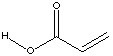
Acrylic acid | |
| |
| Formula | CH2=CHCO2H |
| Structure | |
| Description | A colorless liquid with a distinctive acrid odor. |
| Uses | Chemical intermediate for ethyl acrylate, n-butyl acrylate, methyl acrylate, 2-ethylhexyl acrylate, for other specialty acrylates, eg, hydroxyethyl, monomer for polyacrylic acid & salts, eg, thickeners, comonomer with acrylamide for polymers used as flocculants, with ethylene for ion exchange resin polymers, with methyl ester for polymers, eg, thickeners, for other copolymers, eg, with itatonic acid. |
Registry Numbers. | |
| CAS | 79-10-7 |
| EINECS | 201-177-9 |
| RTECS | AS4375000 |
| Std. Transport No. | 4931405 |
| RCRA | U008 |
| UN (DOT) | 2218 |
| Beilstein Reference | 4-02-00-01455 |
| Beilstein Number | 635743 |
| Merck Index | 132 |
| 79-10-7 is listed on the TSCA. | |
Chemical and physical properties. | |
| Formula mass | 72.06 |
| Melting point, °C | 12.8 |
| Boiling point, °C | 141 |
| Vapor pressure, mmHg | 4 |
| Vapor density (air=1) | 2.5 |
| Specific gravity/density | 1.0497 |
| Solubility in water | Soluble |
| Refractive index | 1.4224 |
| Odor threshold | 1.04 ppm |
| Partition coefficient, pKow | 0.35 |
| Equilibrium constant | pKa = 4.25 at 25 oC |
Hazards and protection. | |
| Storage | Keep in a cool, dry, dark location in a tightly sealed container or cylinder. Keep away from incompatible materials, ignition sources and untrained individuals. Secure and label area. Protect containers/cylinders from physical damage. |
| Handling | All chemicals should be considered hazardous. Avoid direct physical contact. Use appropriate, approved safety equipment. Untrained individuals should not handle this chemical or its container. Handling should occur in a chemical fume hood. |
| Protection | Wear appropriate protective gloves, clothing and goggles. |
| Respirators | Wear positive pressure self-contained breathing apparatus (SCBA). |
| Small spills or leaks | Keep sparks, flames, and other sources of ignition away. Keep material out of water sources and sewers. Build dikes to contain flow as necessary. Use water spray to knock-down vapors. Neutralize spilled material with crushed limestone, soda ash, or lime. |
| Stability | No data. |
| Incompatibilities | It |
| Other hazards | May react violently with water. |
Fire related information. | ||||
| NFPA | Health | 2 |

 
 |
|
| Flammability | 3 | |||
| Reactivity | 2 | |||
| Special | - | |||
| Flash Point,°C | 51 | |||
| Autoignition temp., °C | 438 | |||
| Upper exp. limit, % | 20.2 | |||
| Lower exp. limit, % | 2.4 | |||
| Fire fighting | Do not extinguish fire unless flow can be stopped. Use water in flooding quantities as fog. Solid streams of water may be ineffective. Cool all affected containers with flooding quantities of water. Apply water from as far a distance as possible. Use alcohol foam, dry chemical or carbon dioxide. Use water spray to knock-down vapors. | |||
| Fire potential | Flammable liquid. A fire hazard when exposed to heat or flame. | |||
| Hazards | Vapors may form explosive mixtures with air. Vapors may travel to source of ignition and flash back. Most vapors are heavier than air. They will spread along ground and collect in low or confined areas (sewers, basements, tanks). Vapor explosion hazard indoors, outdoors or in sewers. | |||
| Combustion products | Toxic vapors are generated when heated May polymerize and explode | |||
Health related information. | |
| Exposure limit(s) | TLV (as TWA): 2 ppm; 5.9 mg/m3 A4 (skin) (ACGIH 1997). NIOSH REL: TWA 2 ppm (6 mg/m3) skin |
Exposure effects | |
| Was neither embryotoxic nor teratogenic in rats by inhalation. Intraperitoneal doses in pregnant rats resulted in decreased birth weight, skeletal abnormalities, and resorptions. | |
| Ingestion | Burning sensation, weakness, abdominal cramps, diarrhorea, Shock, Corrosive, Unconsciousness. |
| Inhalation | Irritant effects may occur from acute inhalation. |
| Skin | Burns may be caused by splash contact. |
| Eyes | Vapors may cause eye irritation. The liquid may cause blindness if splashed into the eye. Vapors will also cause nasal irritation. |
| First aid | |
| Ingestion | DO NOT INDUCE VOMITING. Corrosive chemicals will destroy the membranes of the mouth, throat, and esophagus and, in addition, have a high risk of being aspirated into the victim's lungs during vomiting which increases the medical problems. If the victim is conscious and not convulsing, give 1 or 2 glasses of water to dilute the chemical and IMMEDIATELY call a hospital or poison control center. IMMEDIATELY transport the victim to a hospital. If the victim is convulsing or unconscious, do not give anything by mouth, ensure that the victim's airway is open and lay the victim on his/her side with the head lower than the body. DO NOT INDUCE VOMITING. Transport the victim IMMEDIATELY to a hospital. |
| Inhalation | IMMEDIATELY leave the contaminated area; take deep breaths of fresh air. IMMEDIATELY call a physician and be prepared to transport the victim to a hospital even if no symptoms (such as wheezing, coughing, shortness of breath, or burning in the mouth, throat, or chest) develop. Provide proper respiratory protection to rescuers entering an unknown atmosphere. Whenever possible, Self-Contained Breathing Apparatus (SCBA) should be used. |
| Skin | IMMEDIATELY flood affected skin with water while removing and isolating all contaminated clothing. Gently wash all affected skin areas thoroughly with soap and water. IMMEDIATELY call a hospital or poison control center even if no symptoms (such as redness or irritation) develop. IMMEDIATELY transport the victim to a hospital for treatment after washing the affected areas. |
| Eyes | First check the victim for contact lenses and remove if present. Flush victim's eyes with water or normal saline solution for 20 to 30 minutes while simultaneously calling a hospital or poison control center. Do not put any ointments, oils, or medication in the victim's eyes without specific instructions from a physician. IMMEDIATELY transport the victim after flushing eyes to a hospital even if no symptoms (such as redness or irritation) develop. |
Shipping information. | ||
| DOT (UN) Transportation Information |
 | |
| UN number | 2218 | |
| Response guide | 132 | |
| Hazard class | 8 | |