Chlorothalonil
- 2,4,5,6-Tetrachloro-1,3-benzenedicarbonitrile
- 2,4,5,6-Tetrachloro-3-cyanobenzonitrile
- Tetrachloroisophthalonitrile
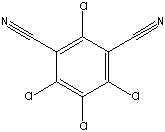
Chlorothalonil | |
| |
| Formula | C8Cl4N2 |
| Structure | |
| Description | Colorless crystals or granules or light gray powder. No odor when pure; technical grade has a slightly pungent odor. |
| Uses | Fungicide on a variety of vegetable crops, peanuts, lawns & turfs. |
Registry Numbers. | |
| CAS | 1897-45-6 |
| EINECS | 217-588-1 |
| RTECS | NT2600000 |
| EPA Pest. No. | 81901 |
| UN (DOT) | 2588 |
| Beilstein Number | 1978326 |
| Merck Index | 2219 |
| 1897-45-6 is listed on the TSCA. | |
Chemical and physical properties. | |
| Formula mass | 265.91 |
| Melting point, °C | 250-251 |
| Boiling point, °C | 350 |
| Vapor pressure, mmHg | <0.01 |
| Partition coefficient, pKow | 4.37x10+2 |
Hazards and protection. | |
| Storage | Keep in cool, dry, ventilated place. Do not store alongside food and feedstuffs. |
| Handling | All chemicals should be considered hazardous. Avoid direct physical contact. Use appropriate, approved safety equipment. Untrained individuals should not handle this chemical or its container. Handling should occur in a chemical fume hood. |
| Protection | Use gloves, apron, rubber or plastic boots; use mask for powders. |
| Respirators | Wear a NIOSH-approved half face respirator equipped with a combination filter cartridge, i.e. organic vapor/acid gas/HEPA (specific for organic vapors, HCl, acid gas, SO2 and a high efficiency particulate filter). |
| Small spills or leaks | If a spill of this chemical occurs, FIRST REMOVE ALL SOURCES OF IGNITION, then you should dampen the solid spill material with acetone and transfer the dampened material to a suitable container. Use absorbent paper dampened with acetone to pick up any remaining material. Seal your contaminated clothing and the absorbent paper in a vapor-tight plastic bag for eventual disposal. Solvent wash all contaminated surfaces with acetone followed by washing with a soap and water solution. Do not reenter the contaminated area until the Safety Officer (or other responsible person) has verified that the area has been properly cleaned. |
| Stability | Thermally stable under normal storage conditions, is stable to alkaline and acid aqueous solutions and to UV light. Technical chlorothalonil. |
| Incompatibilities | May react violently with strong oxidizing acids Incompatible with other oxidizing agents such as peroxides and epoxides. |
| Hazardous Decomposition | May decompose at high temp to emit hydrogen chloride. |
Fire related information. | ||||
| Fire fighting | Fires involving this compound should be controlled with a dry chemical, carbon dioxide or Halon extinguisher. | |||
| Fire potential | Non-Combustible | |||
| Combustion products | Fire may produce irritating, corrosive and/or toxic gases. | |||
Health related information. | |
Exposure effects | |
| Ingestion | Spontaneous emesis may occur. |
| Inhalation | Burning sensation. Irritates the respiratory tract. |
| Skin | Irritant contact dermatitis can occur with exposure to concentrations of greater than 0.01%. Photosensitive and allergic reactions are also possible. |
| Eyes | Redness, pain, blurred vision. |
| First aid | |
| Ingestion | DO NOT INDUCE VOMITING. If the victim is conscious and not convulsing, give 1 or 2 glasses of water to dilute the chemical and IMMEDIATELY call a hospital or poison control center. Be prepared to transport the victim to a hospital if advised by a physician. If the victim is convulsing or unconscious, do not give anything by mouth, ensure that the victim's airway is open and lay the victim on his/her side with the head lower than the body. DO NOT INDUCE VOMITING. IMMEDIATELY transport the victim to a hospital. |
| Inhalation | IMMEDIATELY leave the contaminated area; take deep breaths of fresh air. IMMEDIATELY call a physician and be prepared to transport the victim to a hospital even if no symptoms (such as wheezing, coughing, shortness of breath, or burning in the mouth, throat, or chest) develop. Provide proper respiratory protection to rescuers entering an unknown atmosphere. Whenever possible, Self-Contained Breathing Apparatus (SCBA) should be used. |
| Skin | IMMEDIATELY flood affected skin with water while removing and isolating all contaminated clothing. Gently wash all affected skin areas thoroughly with soap and water. If symptoms such as redness or irritation develop, IMMEDIATELY call a physician and be prepared to transport the victim to a hospital for treatment. |
| Eyes | First check the victim for contact lenses and remove if present. Flush victim's eyes with water or normal saline solution for 20 to 30 minutes while simultaneously calling a hospital or poison control center. Do not put any ointments, oils, or medication in the victim's eyes without specific instructions from a physician. IMMEDIATELY transport the victim after flushing eyes to a hospital even if no symptoms (such as redness or irritation) develop. |
Shipping information. | ||
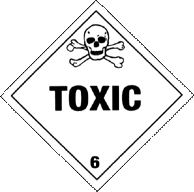
| DOT (UN) Transportation Information |
 | |
| UN number | 2588 | |
| Response guide | 151 | |
| Hazard class | 6.1 | |